







Opening now...

You’ll need to use a desktop browser to set up your Streak account. You can install Streak now and finish setup on desktop later.
To get started with Chrome, install Streak from the Chrome Web Store on your desktop. Share your email and we'll send you the install link directly.
To get started with Safari, install Streak from the Mac App store on your desktop. Share your email and we'll send you the install link directly.
To get started with Edge, install Streak from the Edge Add-ons store on your desktop. Share your email and we'll send you the install link directly.


If you’ve installed Streak and completed onboarding on desktop, you can install the Streak app to access your pipelines on mobile.



Sales leaders know that timing is everything. Rushing creates too much pressure, not responding fast enough loses momentum, and missing key triggers can cost you the deal.
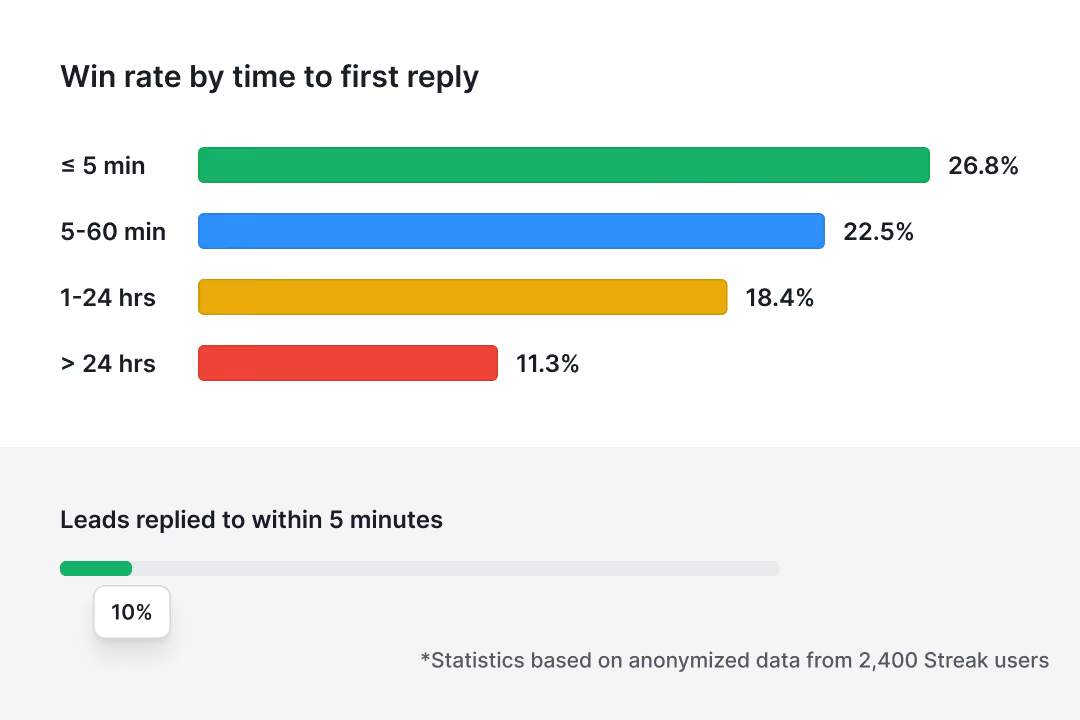
We ran an anonymous study of 2,400 sales teams using Streak in 2026, and found that:
When used properly, AI can be an invaluable addition to your sales teams’ tech stack and help them stay on top of the leads that matter most. Top-performing teams are using AI tools for sales to decrease response time, prioritize leads, reduce data entry, prep for calls, forecast more accurately, and assess deal risk.
This guide outlines practical ways you can integrate AI into your deal flow to improve outcomes.
AI in sales refers to the use of artificial intelligence and machine learning to automate tasks, pull insights, and guide sellers. It can be used for anything from drafting emails and summarizing meetings to predicting prospect behaviors and executing follow-ups. Typical tasks can be bucketed into a few main categories: automation, generative, and agentic.
The teams that are winning in 2026 aren’t working harder; they are using AI to fill specific gaps in their workflow that historically led to lost opportunities. Here are a few ways that AI can help your team become more efficient while deepening customer insights.
Every minute spent logging a call or updating a field is a minute not spent selling. An AI-powered CRM can pull together unstructured data from multiple sources and automatically enter it into the correct field.
For example, AI agents can read your email history, call notes, and meeting records and enter structured data into your CRM, so your pipeline reflects what's actually happening without anyone updating it manually. This is great for classifying leads, tracking key dates, or entering missing deal info.
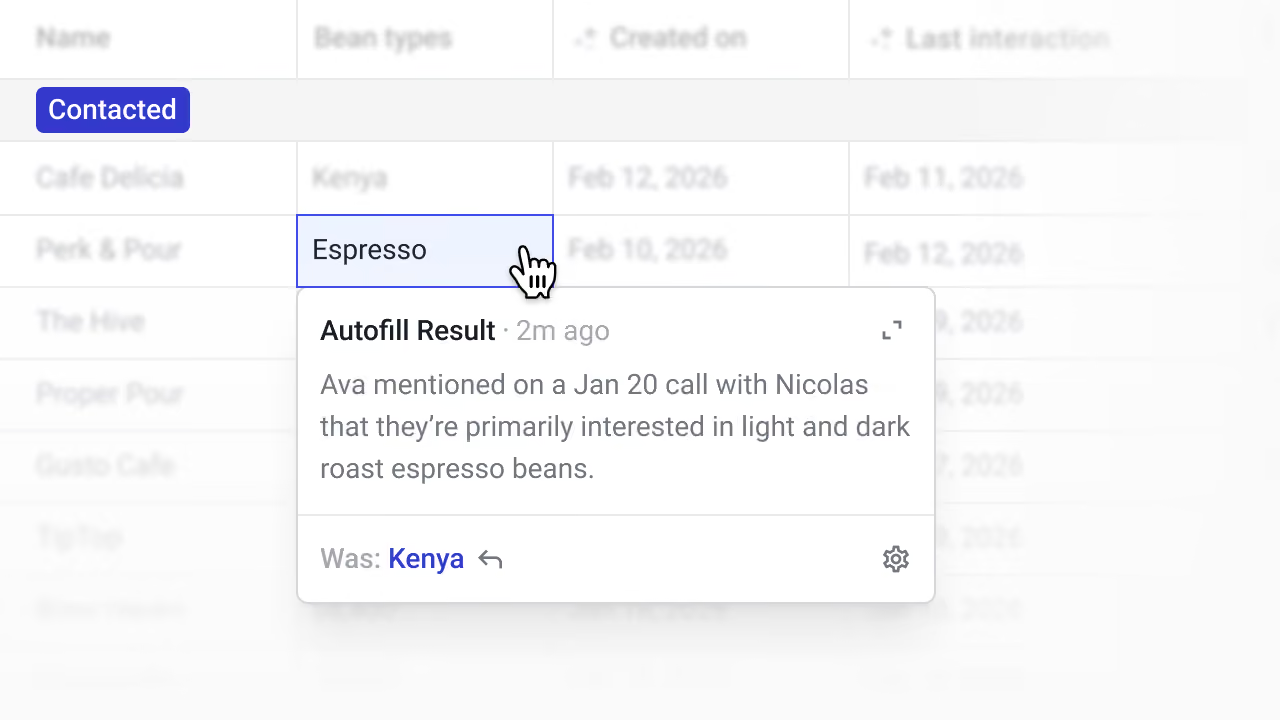
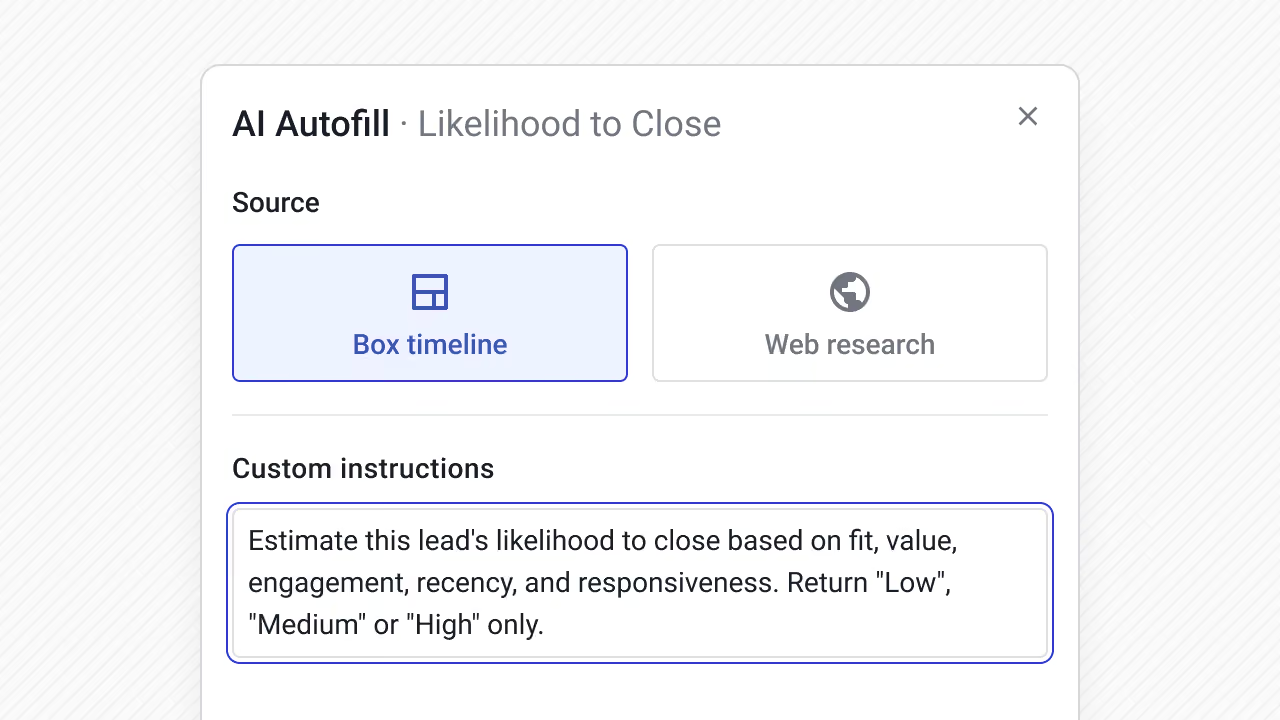
For data that may not exist in your inbox or meeting transcripts, such as company size or industry, AI can search the web and write the results directly into your CRM. Reps don’t have to spend hours scanning LinkedIn and news sites to find out details about your prospects, and you don’t have to integrate a separate lead enrichment tool.
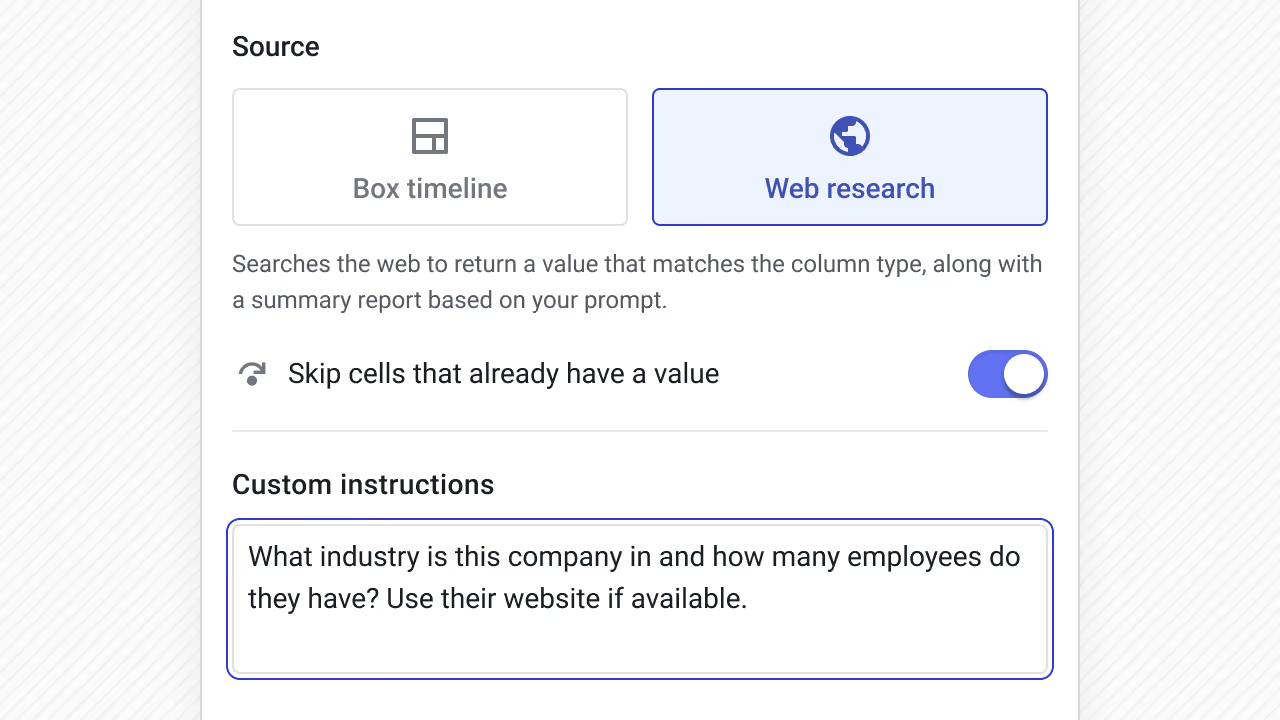
Clean data is key for every downstream action in your sales process, and because data entry is a major sticking point for CRM adoption, using AI to autofill fields can be a game changer.
Every prospect appreciates a personalized touchpoint, but messy notes, missing data, and lack of time can lead to your reps showing up to calls without all the context they need.
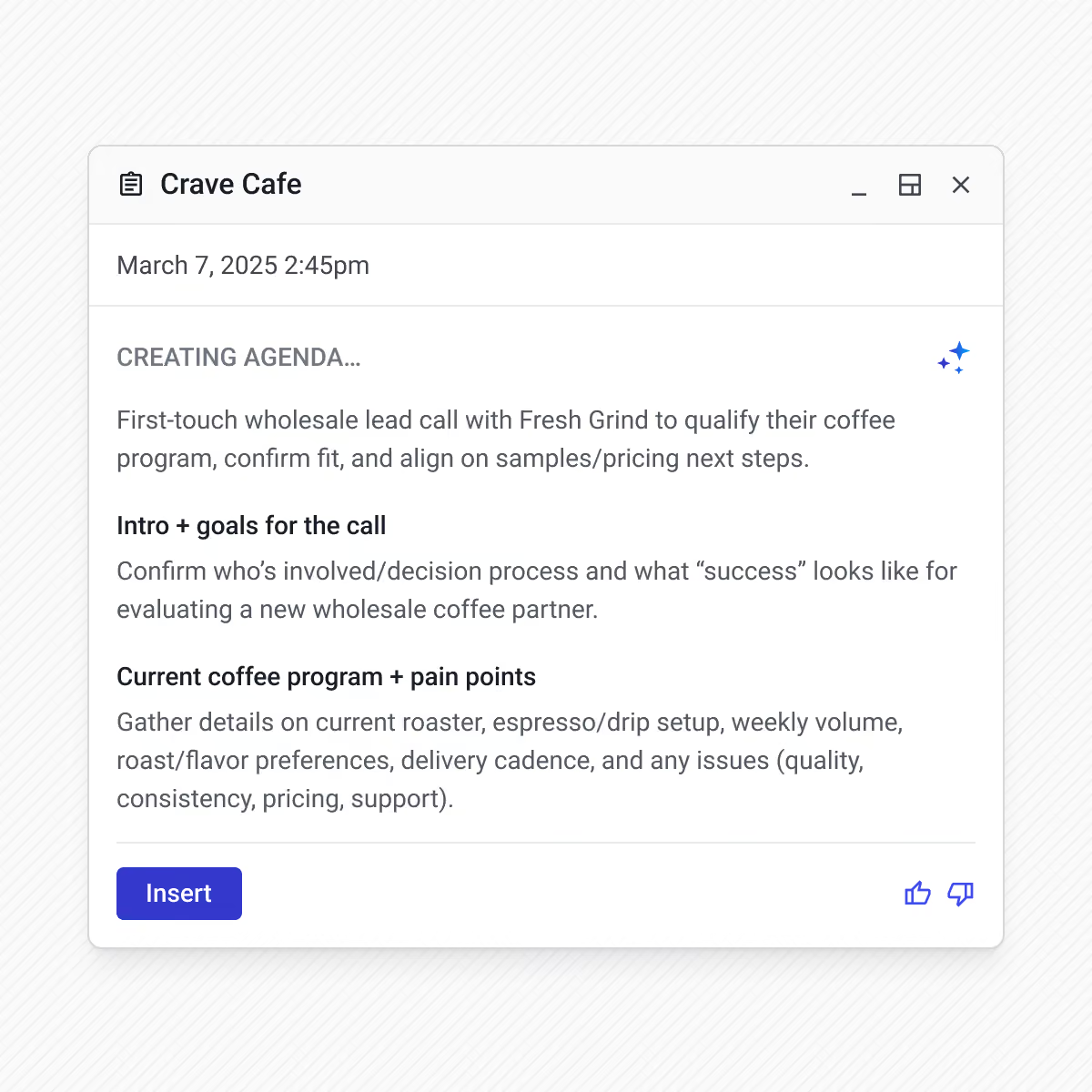
AI can summarize recent deal activity with one click and call out key stalling points that need to be addressed, like competitor mentions, pricing concerns, or needing more buy-in. It can also highlight what the prospect is most interested in, or personal details you can mention to keep building your relationship.
AI summaries can then be used to build and share meeting agendas. This way, both you and your prospect can come prepared. Better prep = better outcomes.
Deals that get a fast reply tend to close more often, and faster. In our proprietary study of real Streak users in 2026, deals that got a reply within 5 minutes were about 2.4x more likely to be won than deals answered after a day, and closed in a median of 2 days instead of 16.*
For busy reps managing lots of contacts, reading long email threads and looking back through notes adds precious minutes to follow-up times.
AI can help reps get up to speed on a deal in seconds with concise summaries and recommended next steps. This frees up time to craft more personalized, thoughtful responses rather than sorting through emails and CRM records.
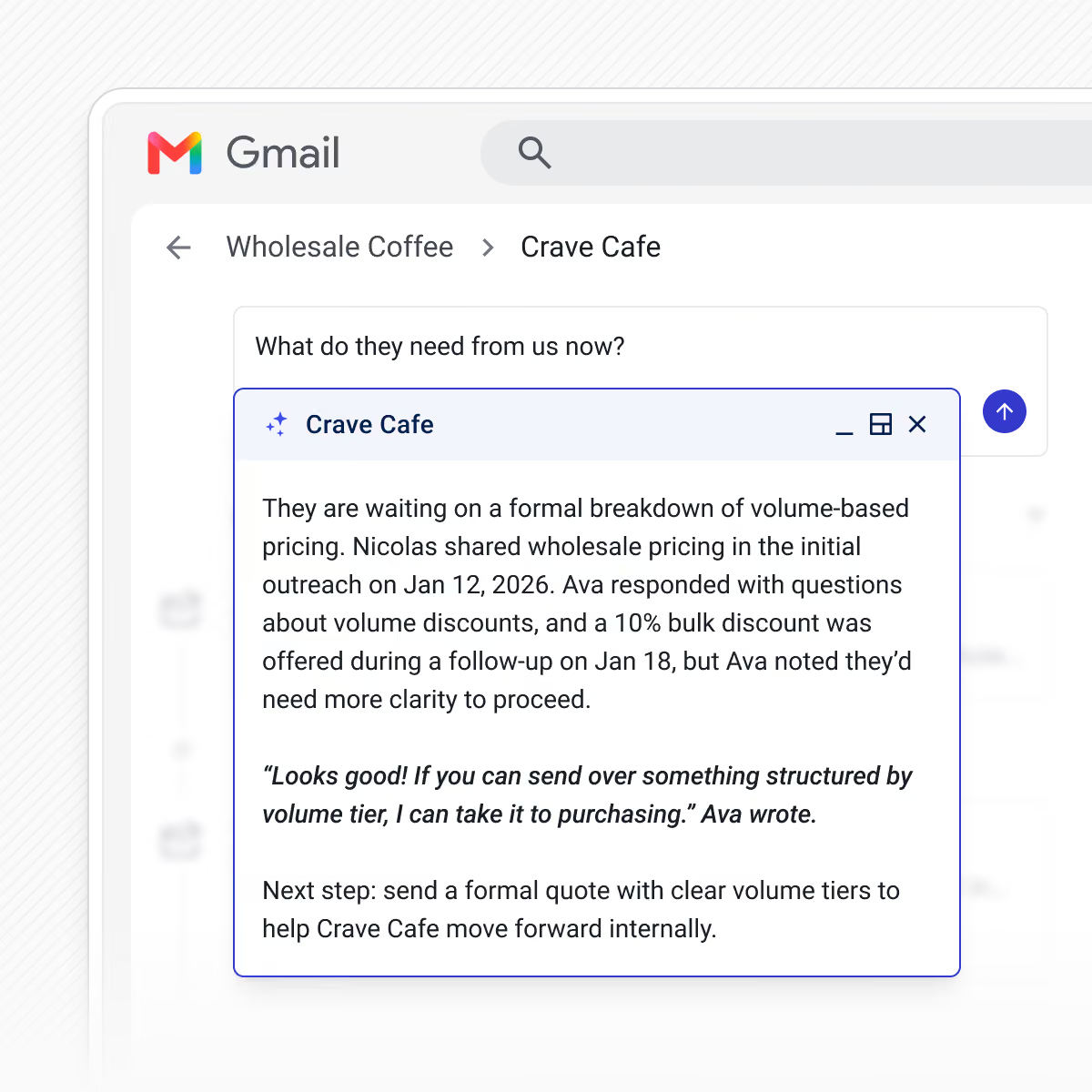
For more repetitive sales inquiries, AI agents can be trained to automatically draft replies on behalf of your reps. Gmail offers a native "Help me write" tool powered by Gemini, but it lacks crucial context from email threads and activity across your team and deal history. Ideally, the reply-drafting agent connects to a CRM that can provide the background information needed to write an accurate, helpful response.
Our data shows that over half of sales follow-up tasks on open deals are overdue.* Usually it’s not that reps don’t care. It’s that follow-ups depend on someone remembering to do them, and a busy week pushes them aside.
AI workflow automation takes the remembering off your reps’ plates. You set the trigger once, and AI handles the rest. When a prospect replies, opens a proposal, or goes quiet for too long, you can build an agent to:
Out-of-date task lists become obsolete quickly. Since 70% of new deals go two weeks or more without a logged email, call, or meeting,* an automated nudge is often what keeps a deal from going cold. Reps stay in control of what gets sent, and nothing slips just because it was a busy week.
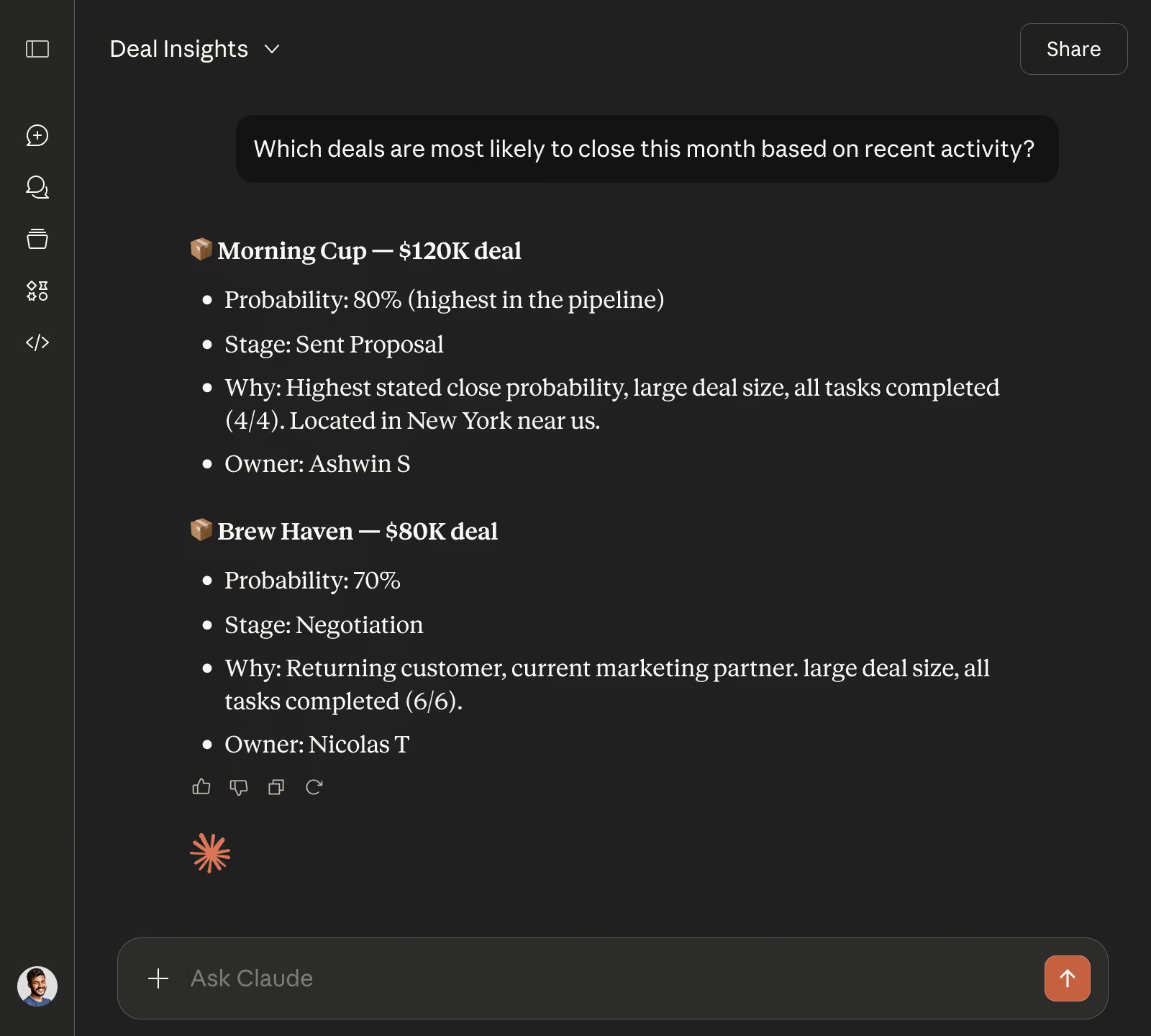
Most CRMs make you click through filters, views, and reports to answer a simple question. With MCP (Model Context Protocol) connections, reps can ask their CRM questions in plain language from AI assistants like Claude or ChatGPT.
Ask things like “Which deals in the proposal stage haven’t heard from us in a week?” or “What did Acme say about pricing on our last call?” and get an answer pulled straight from your pipeline. With Streak’s MCP, you can also take action from the same chat, like moving a deal to a new stage or creating a follow-up task.
Forecasting used to mean spreadsheets, building formulas, and hoping reps updated their deal stages. With AI, advanced data modeling is easier than ever.
Sales managers connect Claude to your CRM through an MCP server and ask something like: “Which deals are most likely to close this quarter based on recent activity?” The AI looks at metrics like engagement, stage movement, and deal value to show where revenue is likely to land and which deals need attention to get there.
Because the forecast is based on real activity rather than gut feel, sales leaders can plan with more confidence and catch shortfalls early enough to fix them.
Not every lead deserves the same amount of attention. AI lead scoring helps your team focus on the deals most likely to close.
Start by defining the parameters of your ideal customer profile (ICP), like company size, industry, budget, or use case, and AI can evaluate new leads against your criteria as soon as they come in. From there, it can flag high-value prospects, disqualify poor-fit leads, and route conversations to the right rep.
The same approach works for open deals. AI can surface risk signals like a stalled conversation, a competitor mention, or a missing decision-maker and provide a “score”, so you can step in before a deal goes sideways.
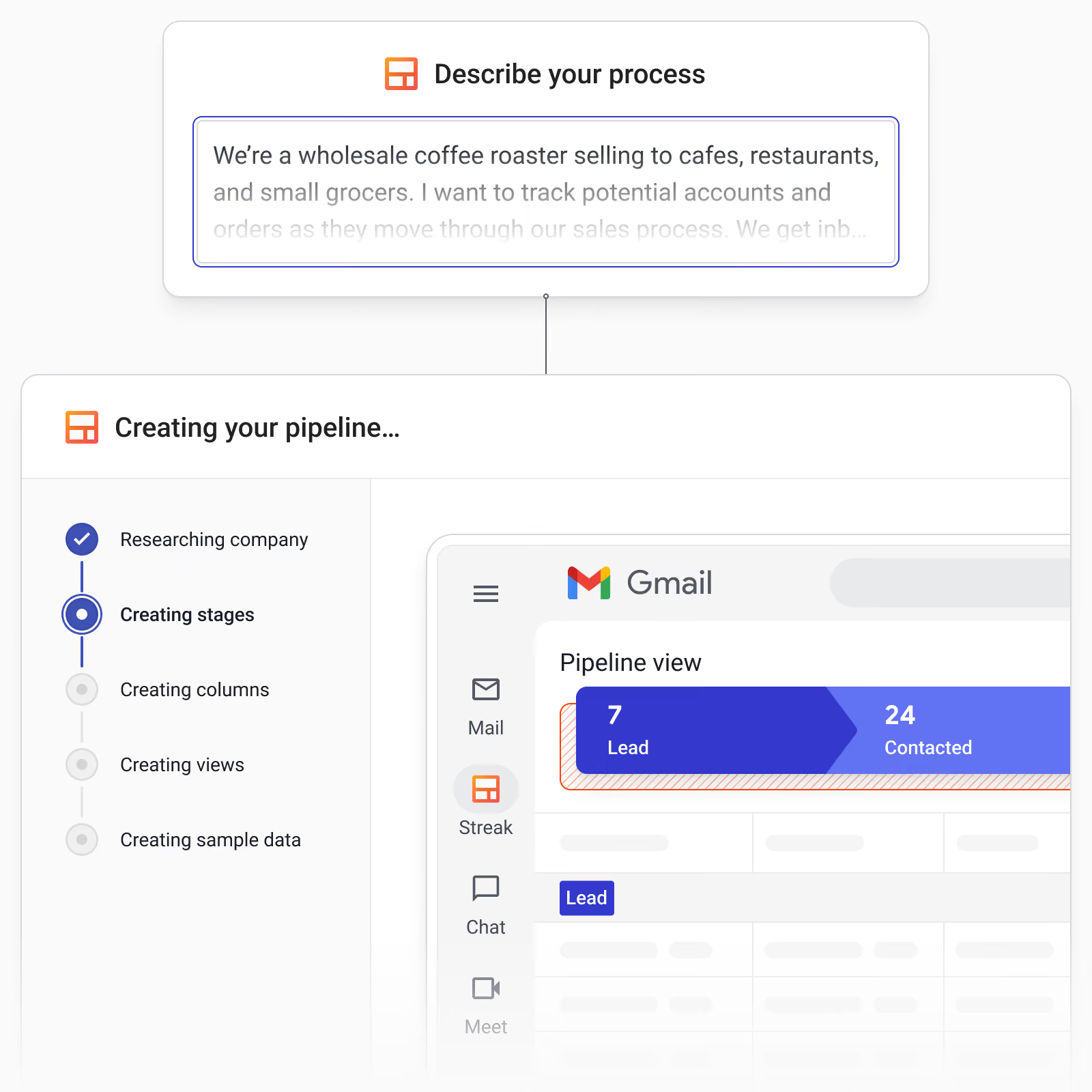
AI makes customization scalable. Streak’s AI can help you build a completely personalized lead funnel using the columns and saved views your business cares about most. Just explain in your own words how your business works and what you’d like to track, and the AI pipeline creator will do the rest.
Streak does the heavy lifting to make sure the back end stays reliable, with your data synced to Gmail and permissions handled for your whole team. Robust infrastructure shouldn’t mean sacrificing flexibility.
Adding AI to your sales process doesn’t have to require a full tech stack overhaul. Teams can see process and performance improvements from starting small, focusing on adoption, and building from there.
AI in sales uses artificial intelligence and machine learning to automate tasks, pull insights, and guide sellers, from drafting emails and summarizing meetings to qualifying and routing leads.
Sales teams use AI to cut manual data entry, prep for calls, respond to leads faster, automate follow-ups, forecast revenue, and score leads.
Find where deals stall in your process, then add trusted AI tools to the workflows your team already uses, with clear rules for when a person reviews AI output.
The best AI tools for sales live where your reps already work, like Streak CRM that autofills data, summarizes deals, and automates follow-ups.
Learn more about how Streak’s native AI features can power your team.
*These statistics are based on anonymized, aggregated data from Streak, a CRM built into Gmail. We analyzed 2,400 paying Streak teams with at least one member who regularly used Streak’s CRM (10+ views) in the 90 days before October 12, 2026. Trial, free, and internal/test accounts were excluded. The dataset covers 3.4 million deals created between October 12, 2025 and October 12, 2026 in 13,939 sales pipelines.*
Stay in the loop with Streak’s latest features and insights.


